
Retailer links on this page are affiliate links. We may earn a commission if you buy, and your price doesn't change. How affiliate links work →
Hiking Boots
Salomon X Ultra 5 Mid GTX Review
Last updated:
My call, up front: the Salomon X Ultra 5 Mid GTX is the boot I'd point most day hikers and weekend backpackers to when they want ankle height without boot weight. REI lists a men's pair at 1 lb 15 oz. That's light. Skip it if your pack runs past 35 pounds, if your feet are wide, or if you mostly hike in summer heat.
It's the successor to the X Ultra 4 Mid GTX, whose Amazon listing now shows no stock and no price. Amazon has carried the X Ultra 5 since July 2024. For this page I read Salomon's spec list, the REI and Amazon listings, and three reviews: OutdoorGearLab, CleverHiker and RunRepeat's lab. The weak spot they agree on is durability. OutdoorGearLab scored it 5 of 10.
 By Brooke6 min read
Share this post
Send it to someone who's planning a trip.
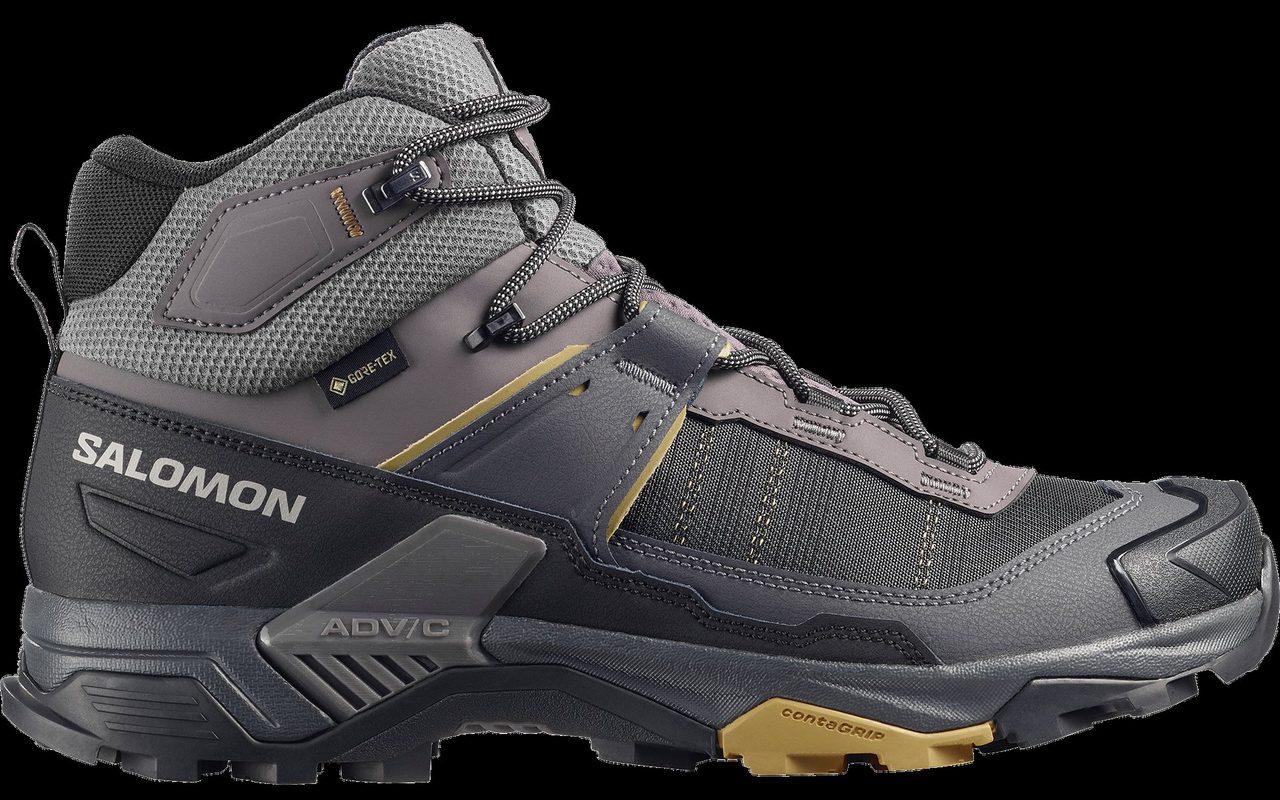
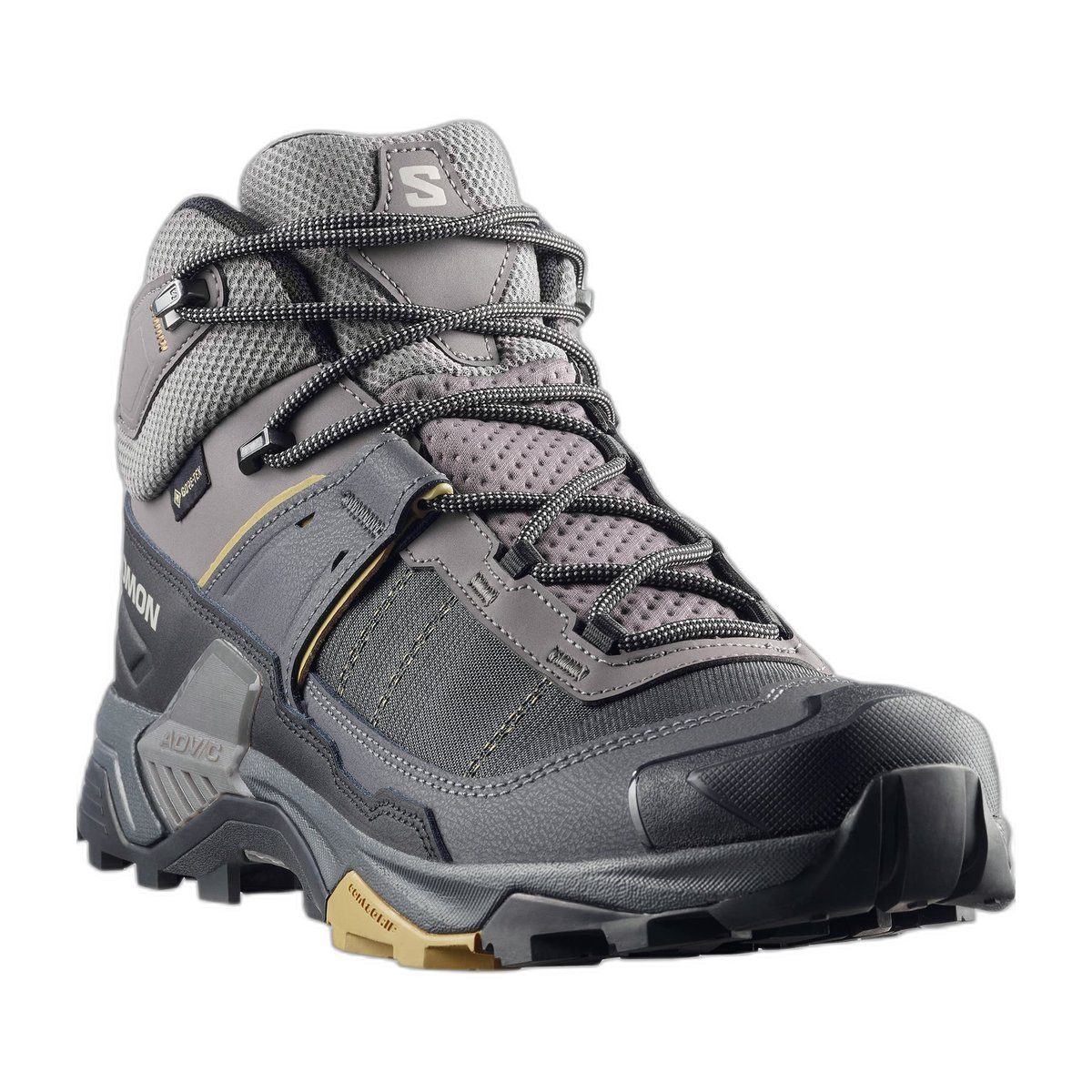
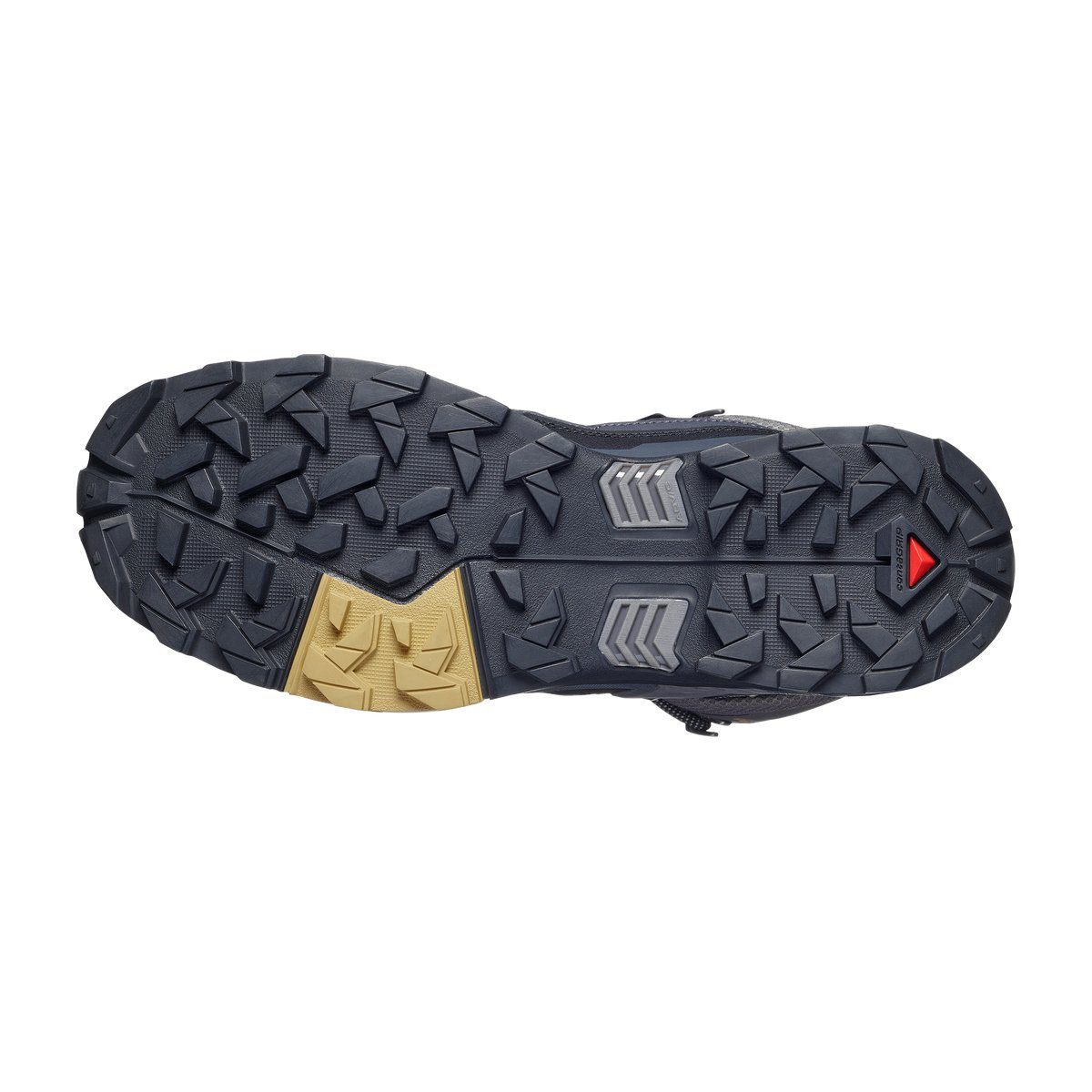
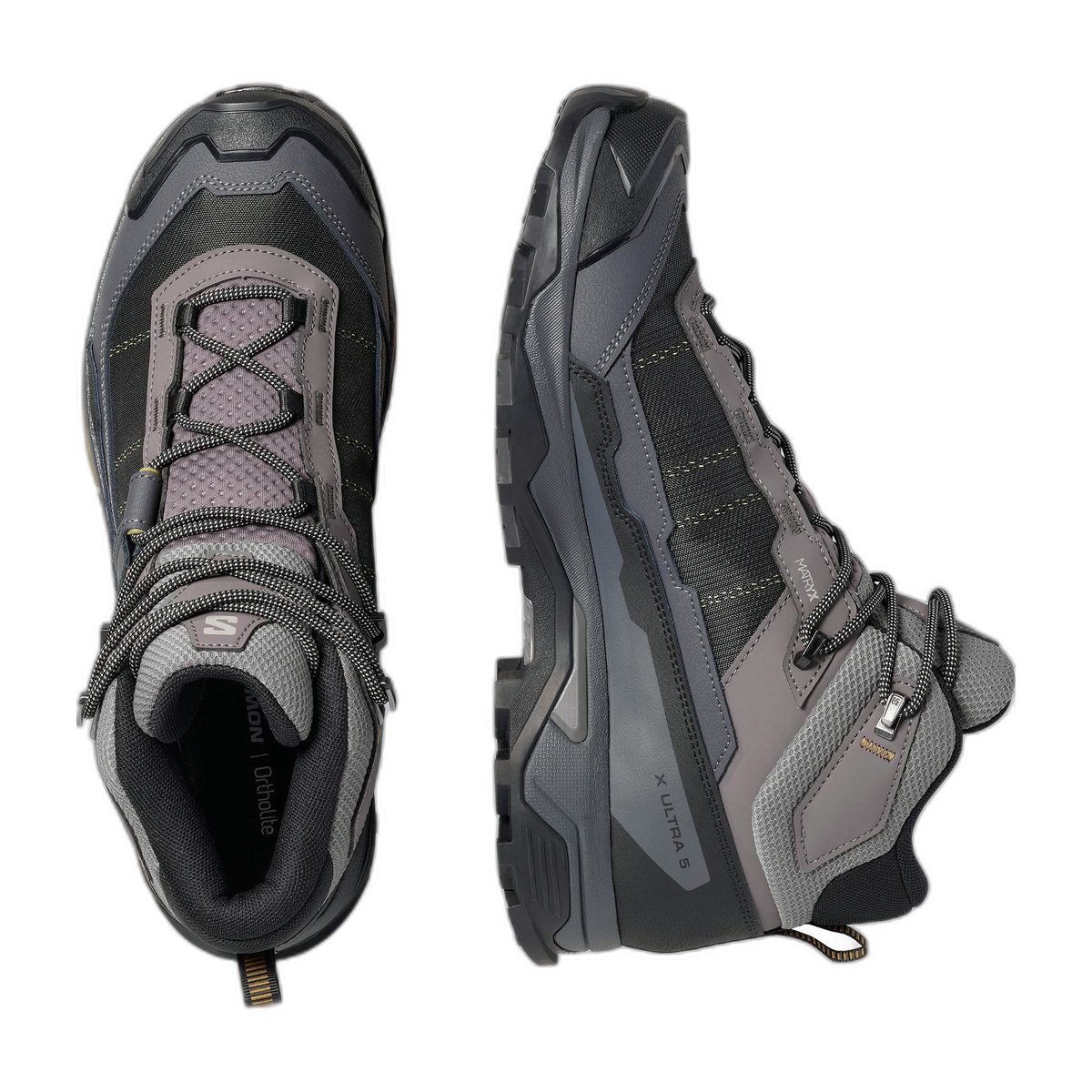
What Changed From the X Ultra 4
Three things changed. One of them shows the moment you look at the laces.
Laces. The X Ultra 4 used QuickLace, Salomon's single pull cord. The X Ultra 5 Mid GTX goes back to regular laces with eyelets, per Salomon's own spec list. You lose the one-tug speed. You get back zone-by-zone tension, and that matters in the fit section below.
Upper. OutdoorGearLab calls the forefoot material the most notable change. The 4 mixed synthetics with leather panels. The 5 uses Matryx, a textile Salomon builds from individually coated Kevlar fibers and technical yarn, over PU-coated leather. OutdoorGearLab credits the swap with fewer seams and less exposed stitching.
Weight. It went up a little. RunRepeat says it got a bit heavier than the 4, and CleverHiker found it breathes less than the 4, too.
The tread barely moved. RunRepeat says the lug pattern hasn't changed in any serious way since the X Ultra 4, pronounced heel brake included. Same grip, new top.
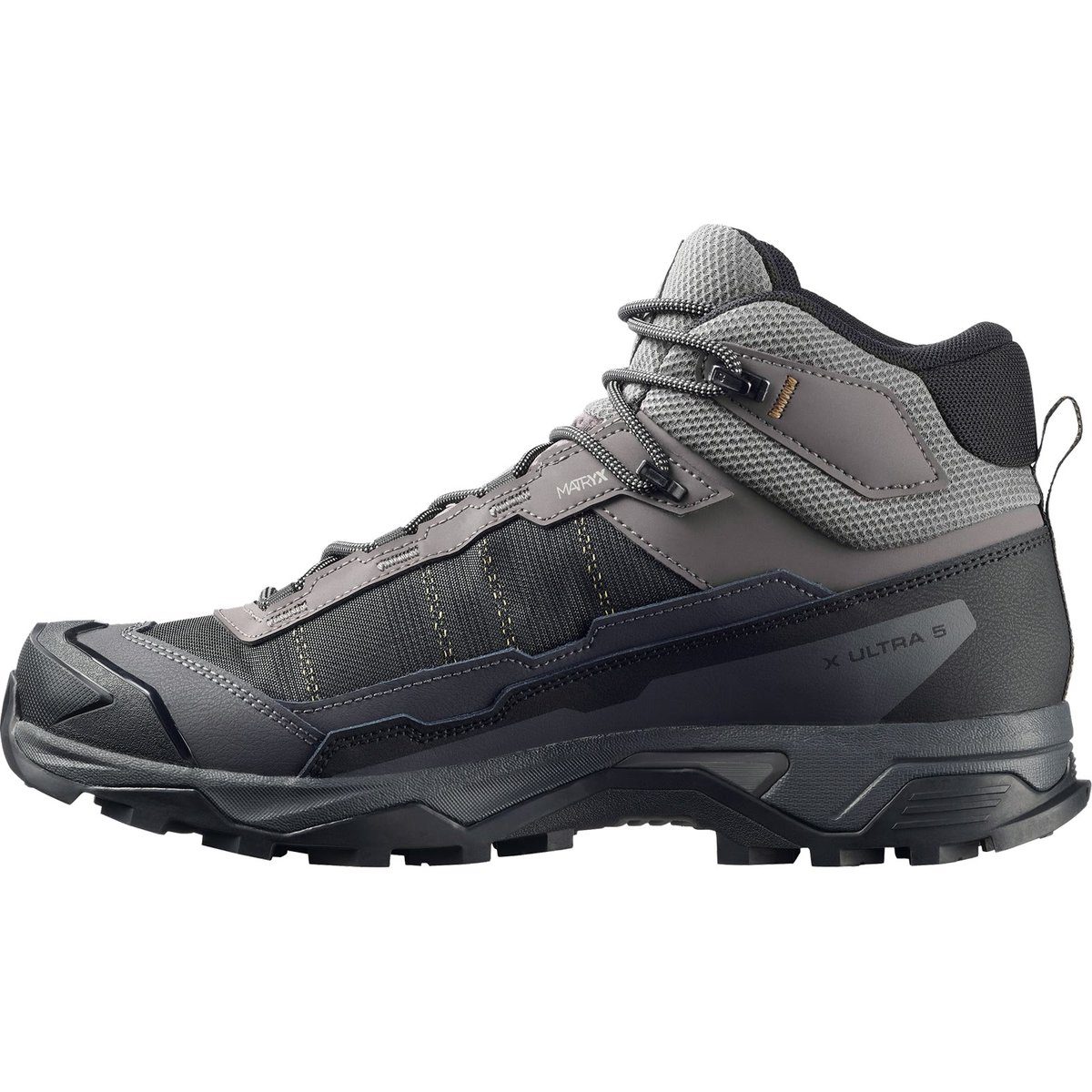
Weight: The Number That Sells It
Here's the sum that makes the case. RunRepeat weighed one X Ultra 5 Mid GTX, men's size 9, at 15.4 oz, against a category average of 18.2 oz. That's 2.8 oz less per boot, or 5.6 oz per pair.
The bigger sizes line up, too. REI lists the men's pair at 1 lb 15 oz, which is 31 oz. OutdoorGearLab quotes Salomon's figure for a size 11 pair at 1.94 lb, and 1.94 times 16 is 31.0 oz. Two sources, one number. I love it when that happens.
Now size up. CleverHiker's size 13 came in at 18.5 oz per boot. OutdoorGearLab's size 14 pair weighed 2.4 lb, and that still sits under the 3.0 lb OutdoorGearLab weighed for the Hoka Kaha 3 GTX in size 14, a gap of 0.6 lb, or 9.6 oz per pair.
The stack is low for a boot. RunRepeat measured 32.5 mm at the heel and 19.8 mm at the forefoot, against averages of 36.0 and 23.5, with a 12.7 mm drop. RunRepeat calls it a trail-connected base. OutdoorGearLab calls the cushion about average.
Fit and Support
Fit splits the reviewers. I think the numbers explain why. RunRepeat measured the widest point at 93.0 mm against a 94.2 mm average, and the toe box at 71.2 mm against 71.8. I'd trust the tape here: average, a hair on the narrow side.
OutdoorGearLab called the fit just right and ordered its usual size. CleverHiker found it snug through the midfoot and toe box, says it runs a touch small, and suggests a half size up if you're between sizes or wear thick socks. Wide feet have an out: Salomon sells an X Ultra 5 Mid Wide Gore-Tex, though CleverHiker found the wide in only one colorway, black.
Support comes from the chassis, not the collar. Salomon's Advanced Chassis is a molded insert in the outsole, and RunRepeat describes a stiff TPU brace around the midfoot. OutdoorGearLab rated support 7 of 10. It found the ankle padding so thick that it had to lace the top tighter once it shouldered a loaded pack. That's where regular laces earn their keep. Crank the ankle, leave the forefoot easy.
The ceiling is load. CleverHiker often carried a 35-pound pack, and past that weight the ankle flex showed and it watched its footing more.
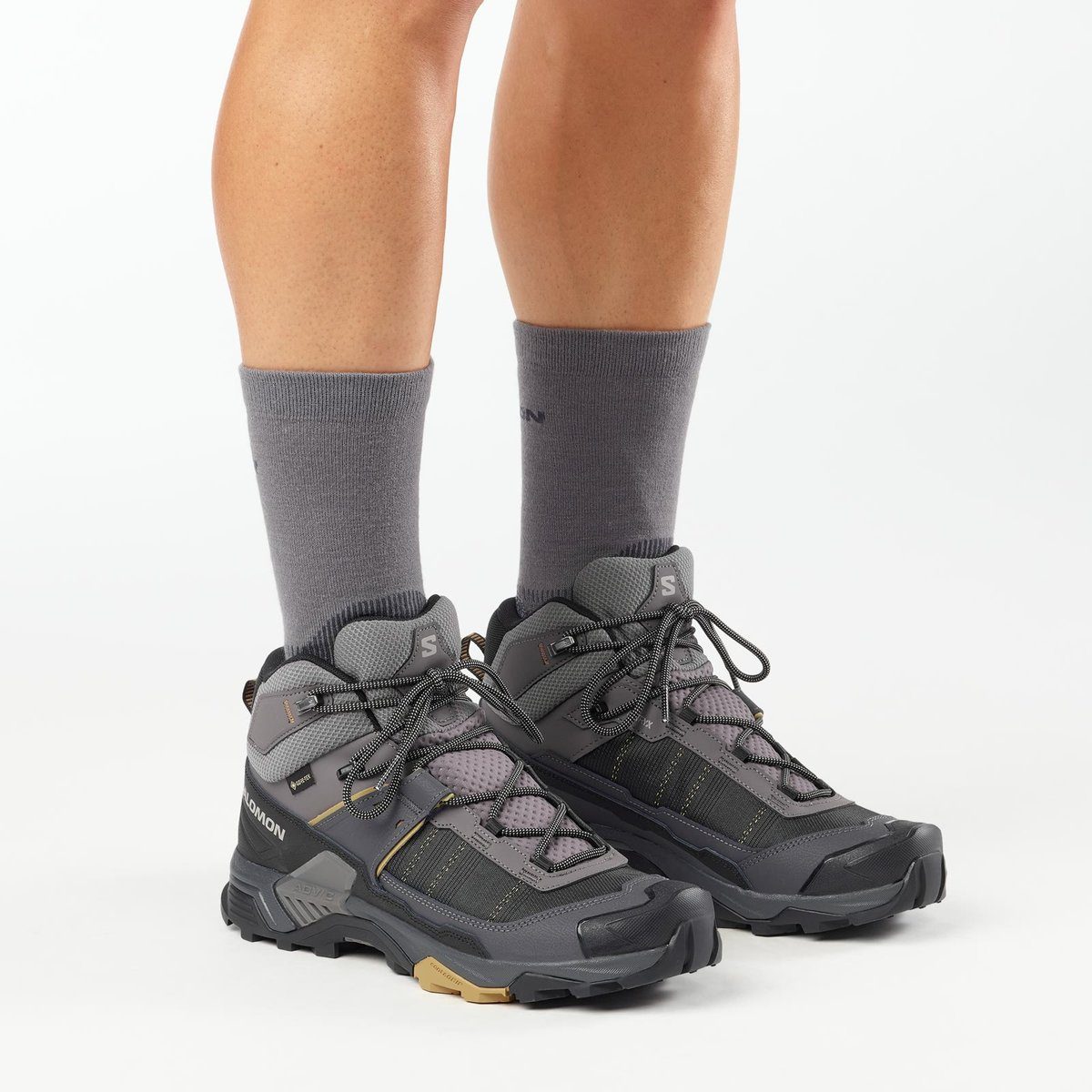
Water and Grip
OutdoorGearLab measured a flood height of 5.25 in and stood in a mountain stream for several minutes without a leak. That height is the spec that counts. Creek splash and boggy mud stop below the collar.
Gore-Tex has limits, though. CleverHiker noticed dampness seeping in at the flex points after a few weeks, mostly on steep wet climbs where the boot bends hardest. It also logged heat buildup on warm hikes. Hot, dry trails? A non-waterproof shoe will run cooler.
Grip is the other strength. OutdoorGearLab scored traction 8 of 10 and liked the heel for braking on forest duff and loose dirt. CleverHiker called the All Terrain Contagrip adaptable on gravel, roots and polished rock. The lugs are only 3.5 mm deep, against a 4.2 mm average in RunRepeat's lab, so deep mud and snow want something chunkier. OutdoorGearLab also found the sole too flexible for easy side-hilling on steep slopes.
Durability: The Weak Score
Durability is the soft spot. OutdoorGearLab gave it 5 of 10, the lowest number on its card, while still calling the sole rugged and the toe caps burly. Its one worry is a metal lace hook anchored in a very soft upper.
CleverHiker saw light scuffs and nicks after rocky miles and scrambles in the Colorado high country. Its pair stayed structurally sound. It also reports that owners online mention lace eyelets breaking and seams splitting near the toe flex point. Watch for it. It's a pattern in owner reports, not a measured failure rate.
Owners overall still like it: 4.4 of 5 from 92 ratings on Amazon and 4.3 from 402 on Salomon's site, both read October 16, 2026. I read that as a well-liked boot with a durability asterisk.
How It Compares
I ran OutdoorGearLab's own category weights over its scores. Comfort counts 30%, support 25%, traction 20%, water resistance and durability 10% each, and weight 5%. The X Ultra 5 comes out at 7.3 of 10.
Vs. Hoka Kaha 3 GTX: 8.4 on the same math, with more cushion and support for heavy packs. It weighed 3.0 lb a pair in size 14, 0.6 lb more.
Vs. Salomon Quest 5 Gore-Tex: 8.2, Salomon's load-hauler. At 3.15 lb it's 0.75 lb heavier.
Vs. Merrell Moab 3 Mid Waterproof: 7.0. It's 2.81 lb, and OutdoorGearLab scored its traction 6 against the Salomon's 8.
Vs. La Sportiva Ultra Raptor II Mid GTX: OutdoorGearLab calls it slimmer, nearly as stable and about the same weight, for more off-trail work.
Pick the X Ultra 5 when weight and grip matter more than cushion. Pick the Kaha 3 when your pack does.
Pros
- 1 lb 15 oz per men's pair (REI); 15.4 oz per men's 9 boot in RunRepeat's lab
- 5.25 in flood height, no leak standing in a stream (OutdoorGearLab)
- Traction 8 of 10 at OutdoorGearLab; heel brake for descents
- Regular laces now, so you can set ankle and forefoot tension apart
Cons
- Durability 5 of 10 at OutdoorGearLab; owner reports of broken eyelets
- Snug and a touch small per CleverHiker; wide in limited colors
- Limits show past about 35 lb loads (CleverHiker)
- Runs warm; CleverHiker found it breathes less than the X Ultra 4
Key Specifications
- Drop
- 12.7 mm, measured (RunRepeat)
- Upper
- PU-coated leather and Matryx textile (Salomon)
- Lacing
- Regular laces with eyelets (Salomon)
- Weight
- 1 lb 15 oz per pair, men's (REI)
- Outsole
- All Terrain Contagrip (Salomon)
- Waterproof
- Yes, Gore-Tex membrane (Salomon)
Get one honest gear take every Friday.
One email a week: new reviews, one gear pick with my reasoning, and nothing sponsored. Confirm your address and you get my printable 2-page backpacking gear checklist.
You'll get a confirmation link first, and nothing else arrives until you click it. Every email has a one-click unsubscribe. How your email is handled
More from Hiking Boots
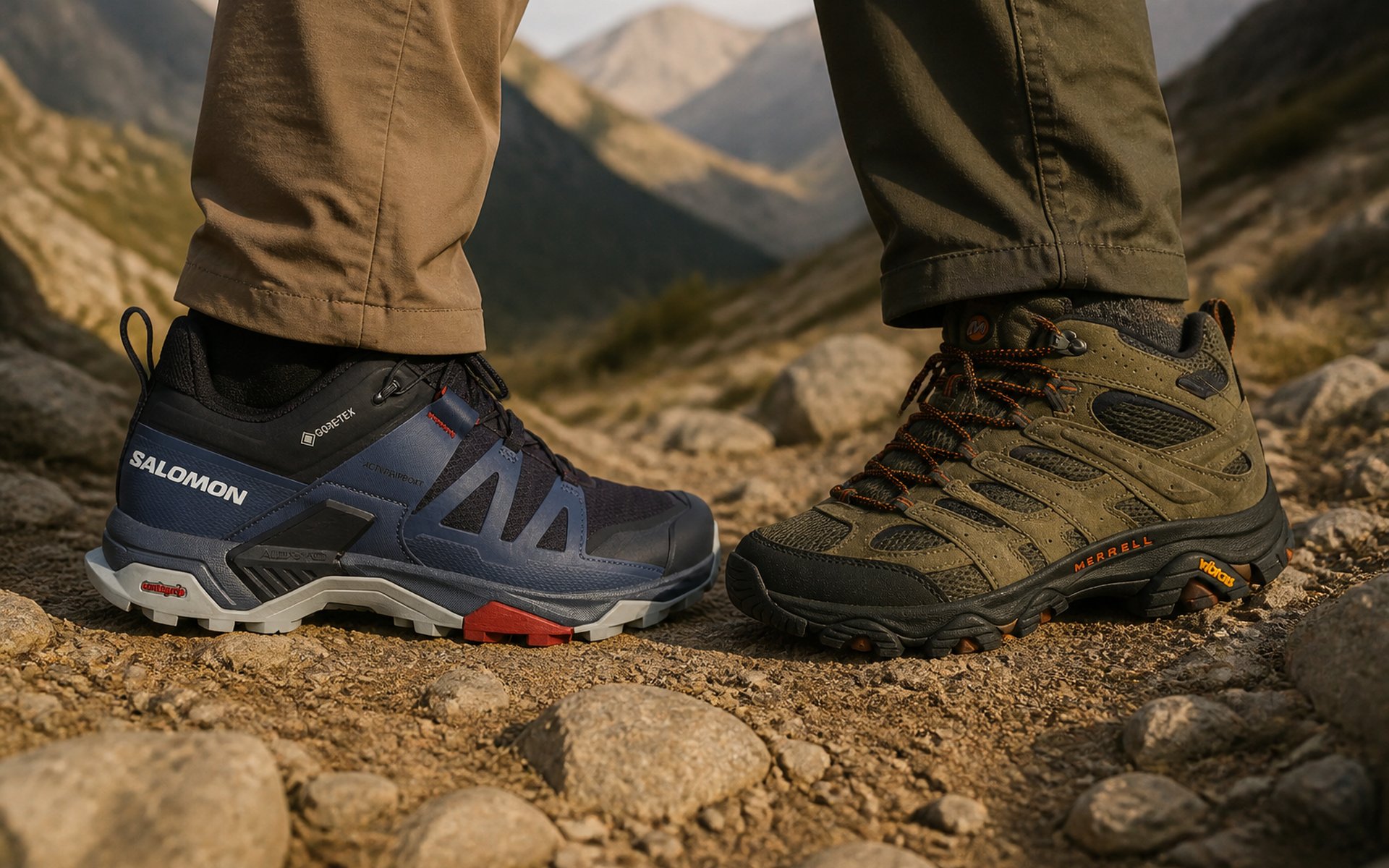
Salomon X Ultra 4 GTX vs Merrell Moab 3 WP: Which Hiking Boot Should You Buy?
The Salomon X Ultra 4 GTX and Merrell Moab 3 WP are two of the most popular hiking footwear choices on the trail. This comparison covers fit, weight, traction, waterproofing, and value to help you decide.
 Brooke Wilder
9 min read
Brooke Wilder
9 min read
Salomon X Ultra 4 Mid GTX vs Altra Lone Peak 8: Waterproof Boot or Zero-Drop Trail Runner
The Salomon wins for wet protection and support. The Lone Peak wins for adapted zero-drop hikers who want less foot weight and faster drying.
Brooke Wilder
10 min read
Why trust BestForBackpacking
Honest gear advice for backpackers, researched, weighed, and recommended.
Every pick is based on deep research: a synthesis of long-term owner reports, independent reviewer tests, and manufacturer specs, weighted by source independence, specificity, and use-case match. Brooke Wilder is our gear editor, the editorial persona who turns that research into a clear recommendation.