
Backpacks
Gregory Paragon 60 vs Osprey Atmos AG LT 65 vs Gossamer Gear Mariposa 60: Pick by Pack Style
Last updated:
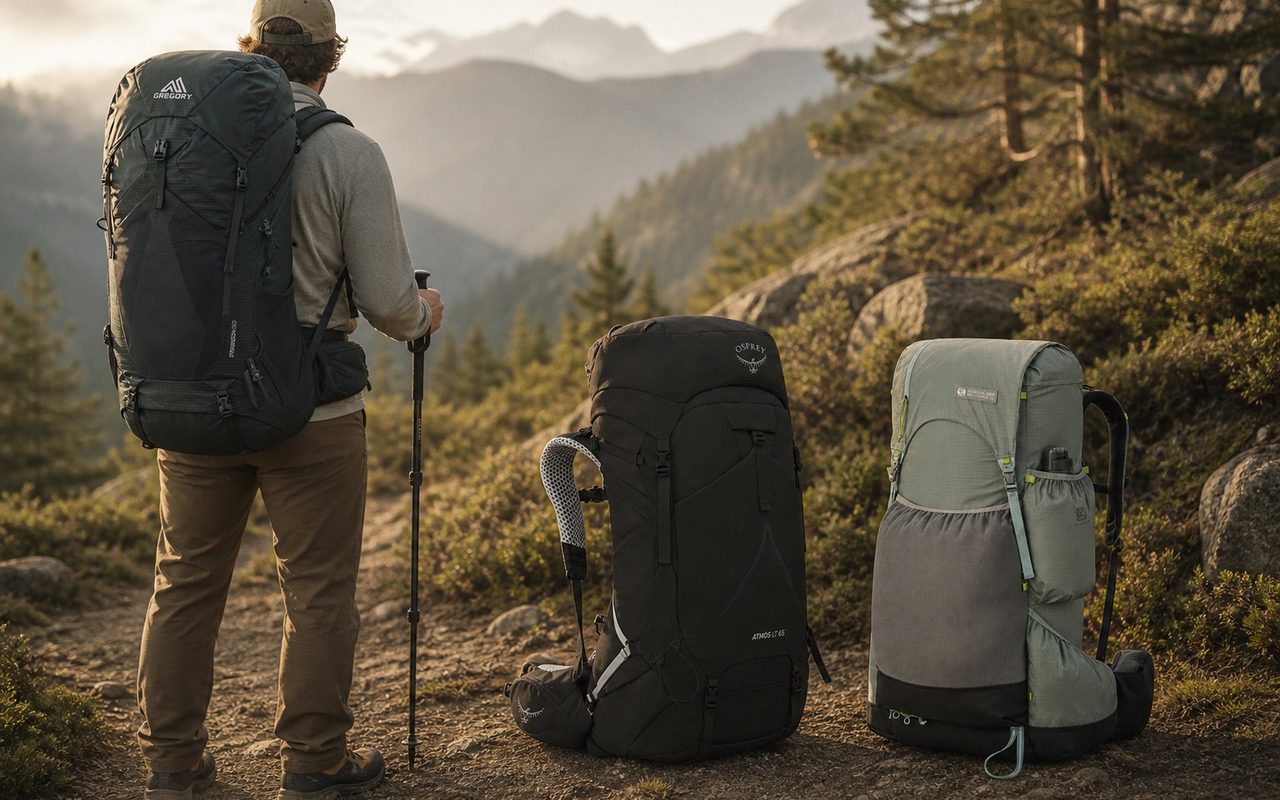
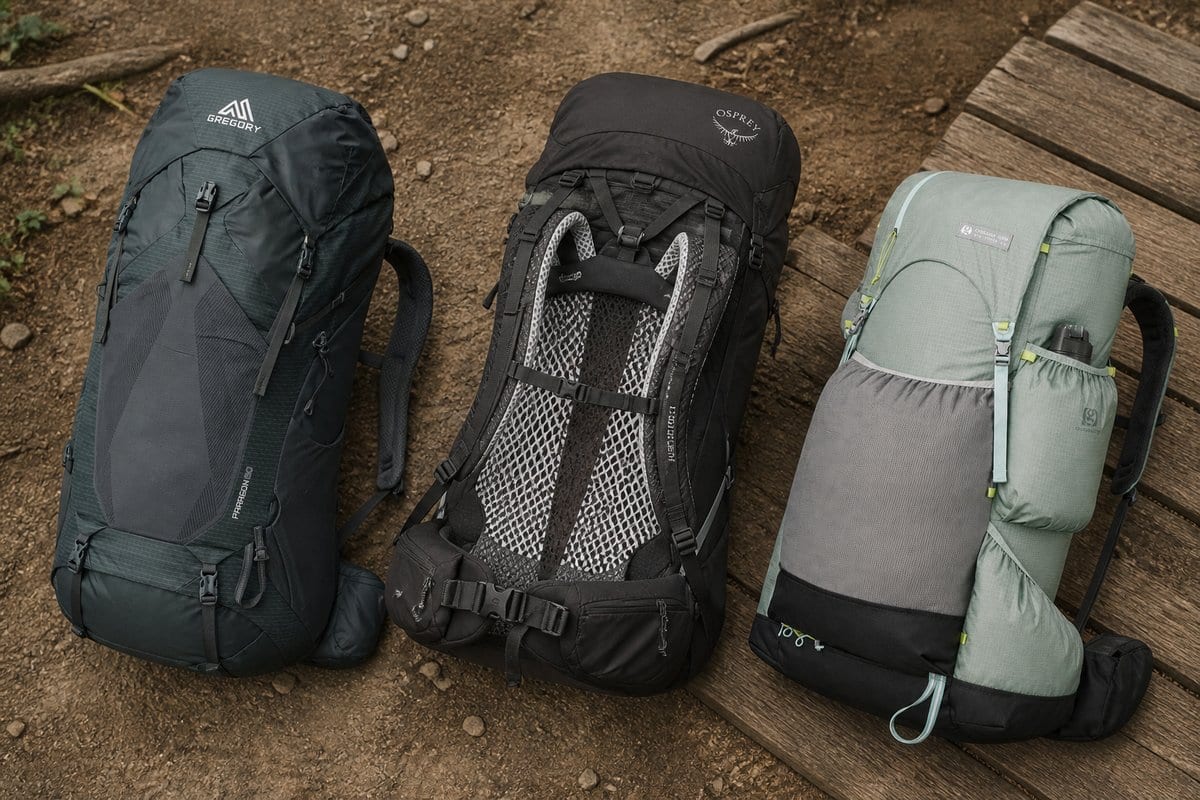
Three very different pack approaches that serve completely different backpackers. Here is how to pick yours.
 By Brooke6 min read
Share this post
Send it to someone who's planning a trip.
Retailer links on this page are affiliate links. We may earn a commission if you buy, and your price doesn't change. How affiliate links work →
Quick picks
My picks at a glance
| Pick | Product | Where to look |
|---|---|---|
| Overall pick | Gregory Paragon 60 | Check price at Gregory → |
| For ventilation-first backpackers who prefer suspended-mesh comfort | Osprey Atmos AG LT 65 | Check price at Amazon → |
| For lightweight backpackers with compact kits near a 30-pound comfort ceiling | Gossamer Gear Mariposa 60 | Check price at Gossamer Gear → |
Full reasoning for each pick is further down the page.
At a glance
The contenders
Gregory Paragon 60
~$290–310typical
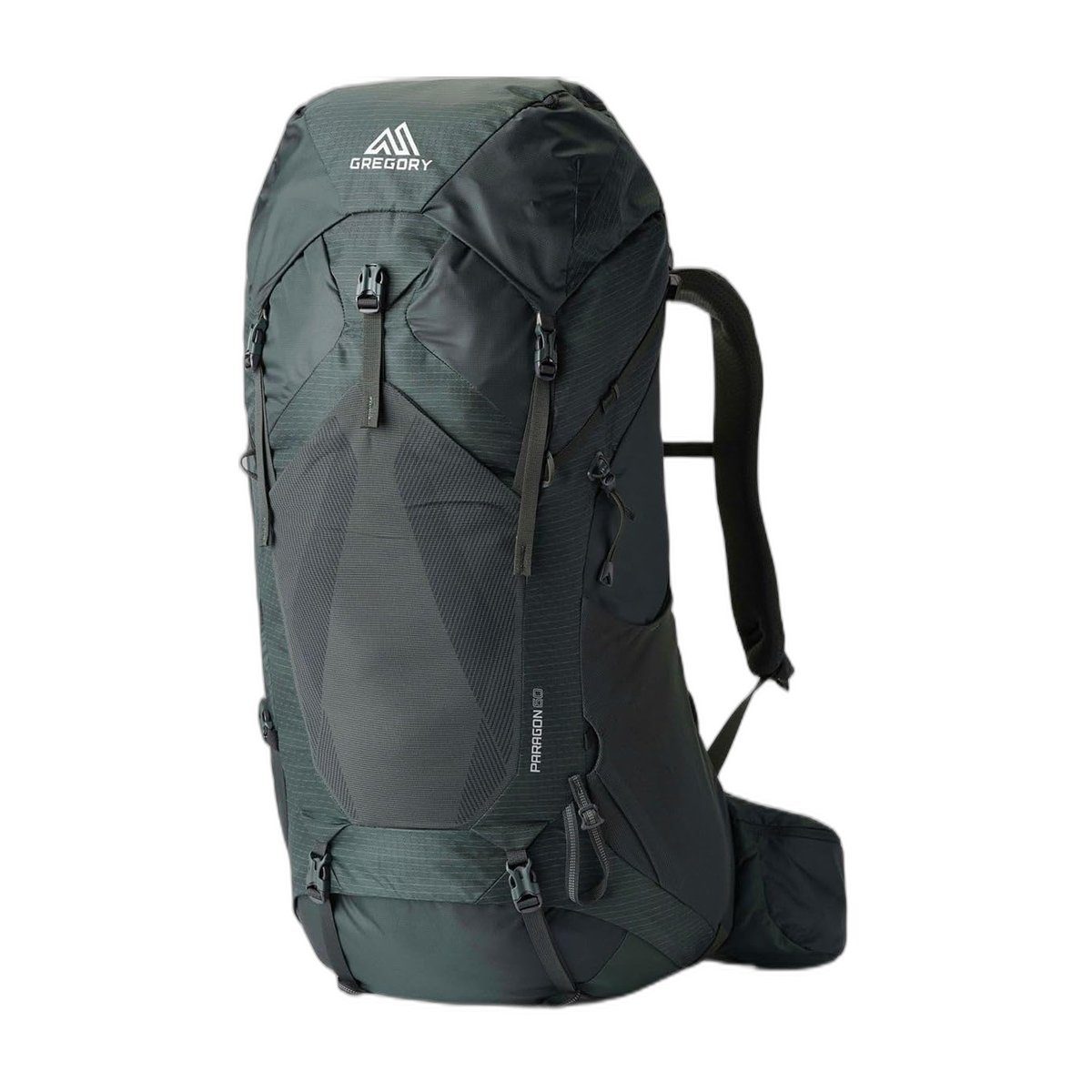
The balanced conventional choice for backpackers who want adjustable fit, a moving hipbelt, useful access, and support without stepping up to a bulkier load hauler.
Osprey Atmos AG LT 65
~$310–330typical
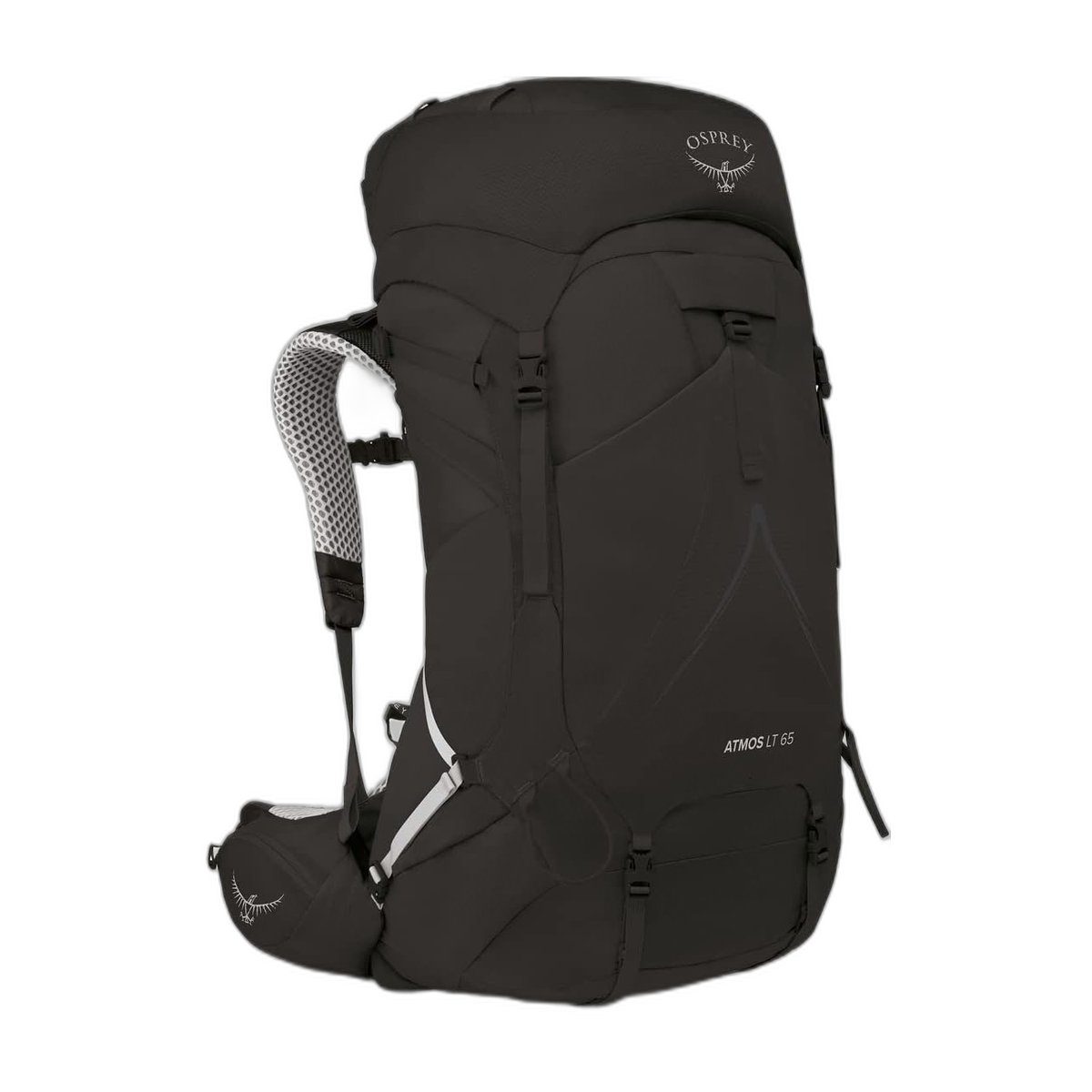
The ventilation specialist, with a suspended-mesh back panel and a streamlined traditional layout for hikers who value an airy, enveloping carry more than low pack weight.
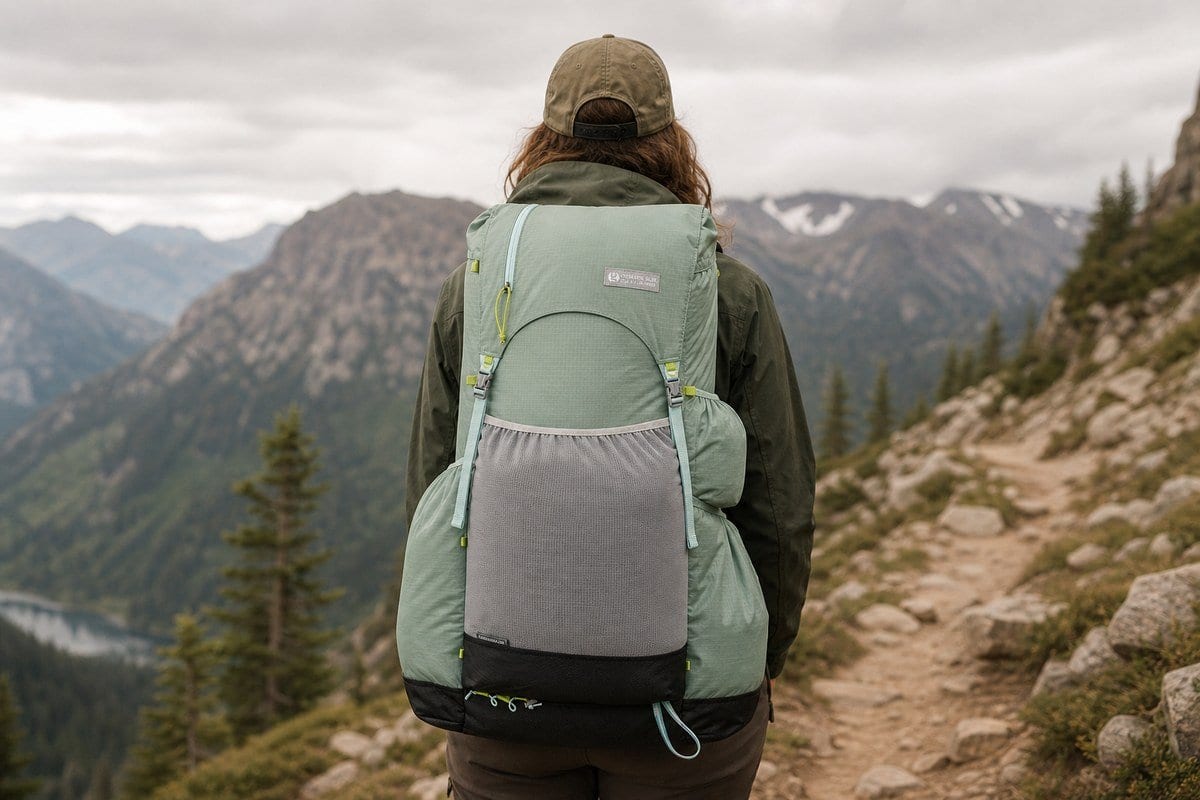
Gossamer Gear Mariposa 60
~$305–325typical
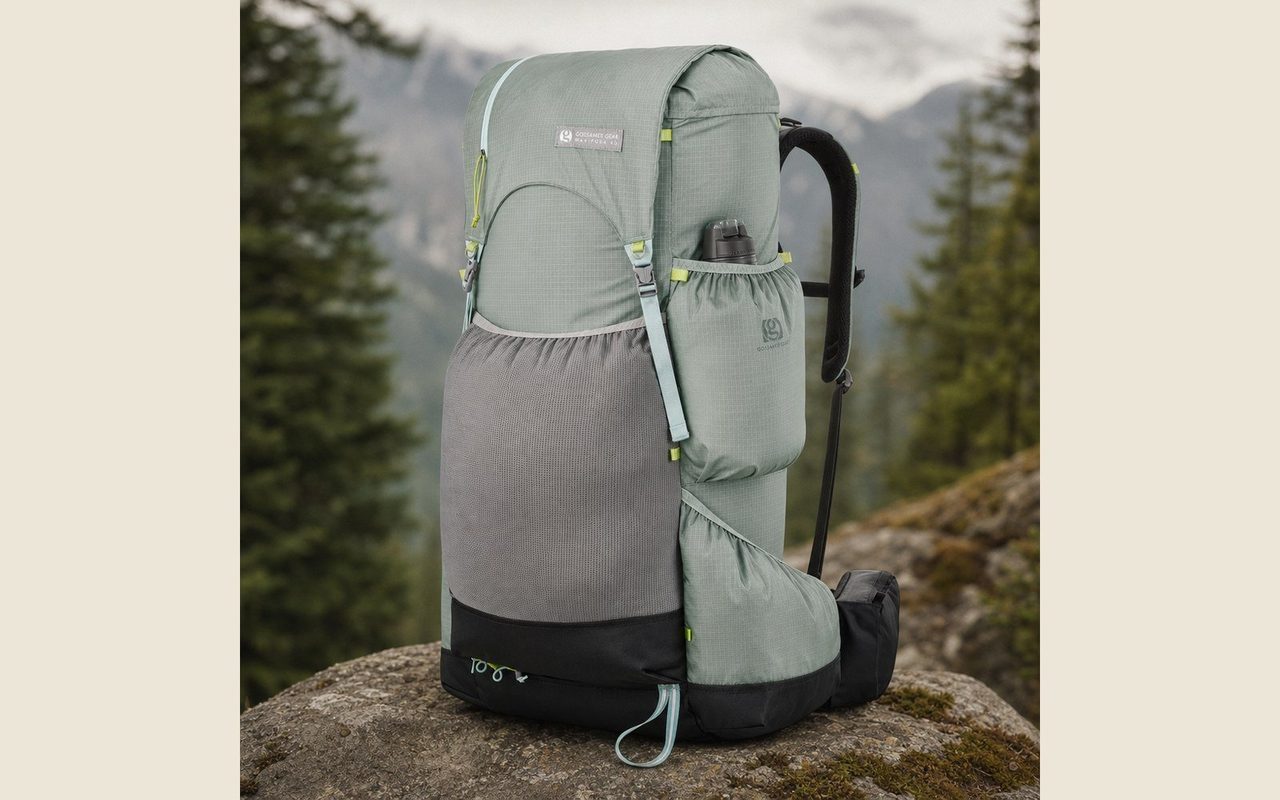
The lightweight crossover for compact kits, combining a removable frame, simple top loading, and generous exterior storage with a firm 30-pound comfort guideline.
Spec check
How they stack up at a glance
| Product | Best for | Price band | Pack weight | Load guidance | Back panel | Access | Owner signal | Buy |
|---|---|---|---|---|---|---|---|---|
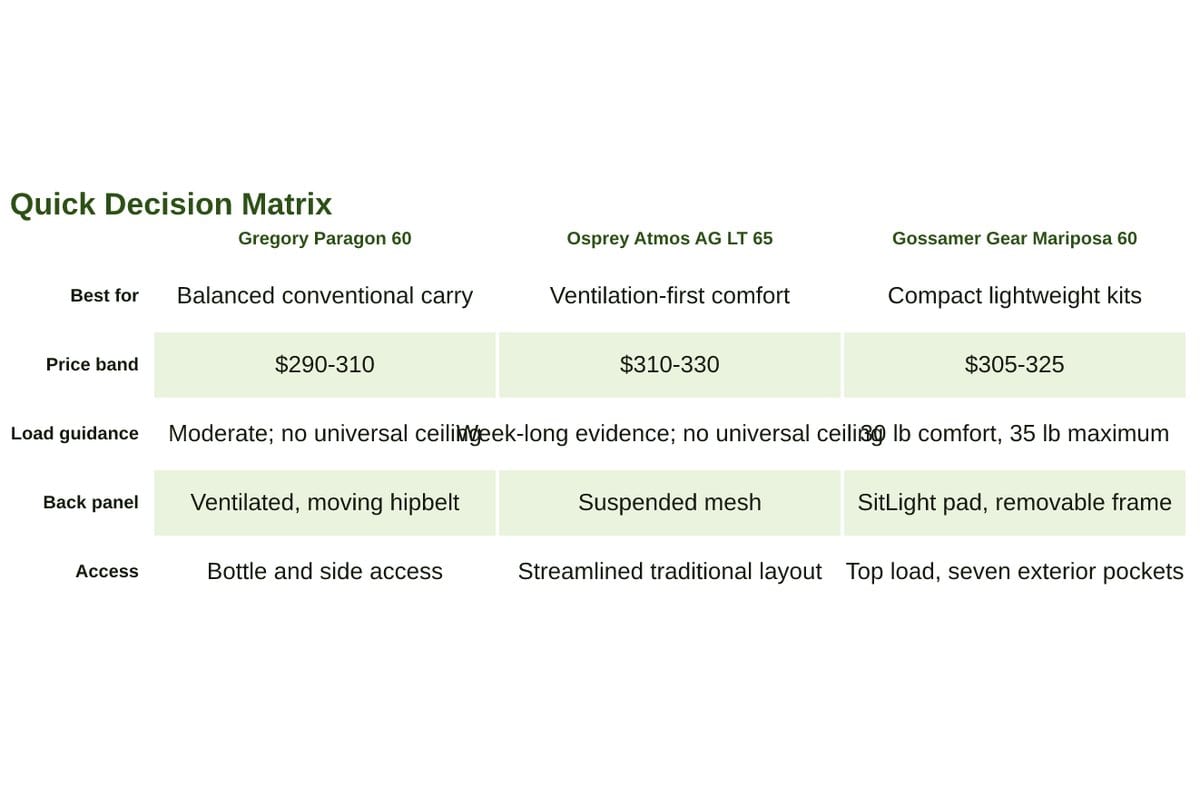
| Gregory Paragon 60 | Balanced conventional carry | ~$290–310 | Not normalized in this comparison | Moderate loads; no verified universal ceiling | Ventilated design, moving hipbelt | Bottle and side access | Amazon 3.1/5, n=2 | Check price → |
| Osprey Atmos AG LT 65 | Ventilation-first comfort | ~$310–330 | Not normalized in this comparison | Week-long carry evidence; no verified universal ceiling | Suspended mesh | Streamlined traditional layout | Amazon 4.8/5, n=135 | Check price → |
| Gossamer Gear Mariposa 60 | Compact lightweight kits | ~$305–325 | 34.2-35.7 oz complete, medium | 30 lb comfort, 35 lb maximum | SitLight pad, removable frame | Top load, seven exterior pockets | No valid aggregate | Check price → |
Gregory Paragon 60
- Best for
- Balanced conventional carry
- Price band
- ~$290–310
- Pack weight
- Not normalized in this comparison
- Load guidance
- Moderate loads; no verified universal ceiling
- Back panel
- Ventilated design, moving hipbelt
- Access
- Bottle and side access
- Owner signal
- Amazon 3.1/5, n=2
Osprey Atmos AG LT 65
- Best for
- Ventilation-first comfort
- Price band
- ~$310–330
- Pack weight
- Not normalized in this comparison
- Load guidance
- Week-long carry evidence; no verified universal ceiling
- Back panel
- Suspended mesh
- Access
- Streamlined traditional layout
- Owner signal
- Amazon 4.8/5, n=135
Gossamer Gear Mariposa 60
- Best for
- Compact lightweight kits
- Price band
- ~$305–325
- Pack weight
- 34.2-35.7 oz complete, medium
- Load guidance
- 30 lb comfort, 35 lb maximum
- Back panel
- SitLight pad, removable frame
- Access
- Top load, seven exterior pockets
- Owner signal
- No valid aggregate
Pick by scenario
Who This Comparison Is For
Jump straight to the winner for how you hike.
| Scenario | Best pick |
|---|---|
| Weekender | Gregory Paragon 60 |
| First-timer | Gregory Paragon 60 |
| Desert | Osprey Atmos AG LT 65 |
| Ultralight | Gossamer Gear Mariposa 60 |
| Thru-hiker | Gossamer Gear Mariposa 60 |
Weekender
Gregory Paragon 60
First-timer
Gregory Paragon 60
Desert
Osprey Atmos AG LT 65
Ultralight
Gossamer Gear Mariposa 60
Thru-hiker
Gossamer Gear Mariposa 60
The Decision in One Minute
Buyer rule: match the pack to your load range first, your feature preferences second.
Pick the Gregory Paragon 60 if you carry a moderate conventional load and want adjustable fit, a moving hipbelt, side-access convenience, and bottle pockets you can reach without stopping. It is the safest starting point for most backpackers because it balances support and access without requiring a ultralight kit.
Pick the Osprey Atmos AG LT 65 if back ventilation and suspended comfort matter more than pack weight. Its suspended mesh creates the largest air gap among these three, which helps on warm exposed trails. You trade some weight and access simplicity for that airflow.
Pick the Gossamer Gear Mariposa 60 only if your full carry normally stays near or under its 30-pound comfort guidance and your gear fits a compact top-loading system with exterior pockets. It is a lightweight crossover, not a heavy-load substitute.
The standard Atmos AG 65 is not ranked here because a current official product page could not be verified, so no evidence from that model is carried over.
Fit and Load Come Before Features
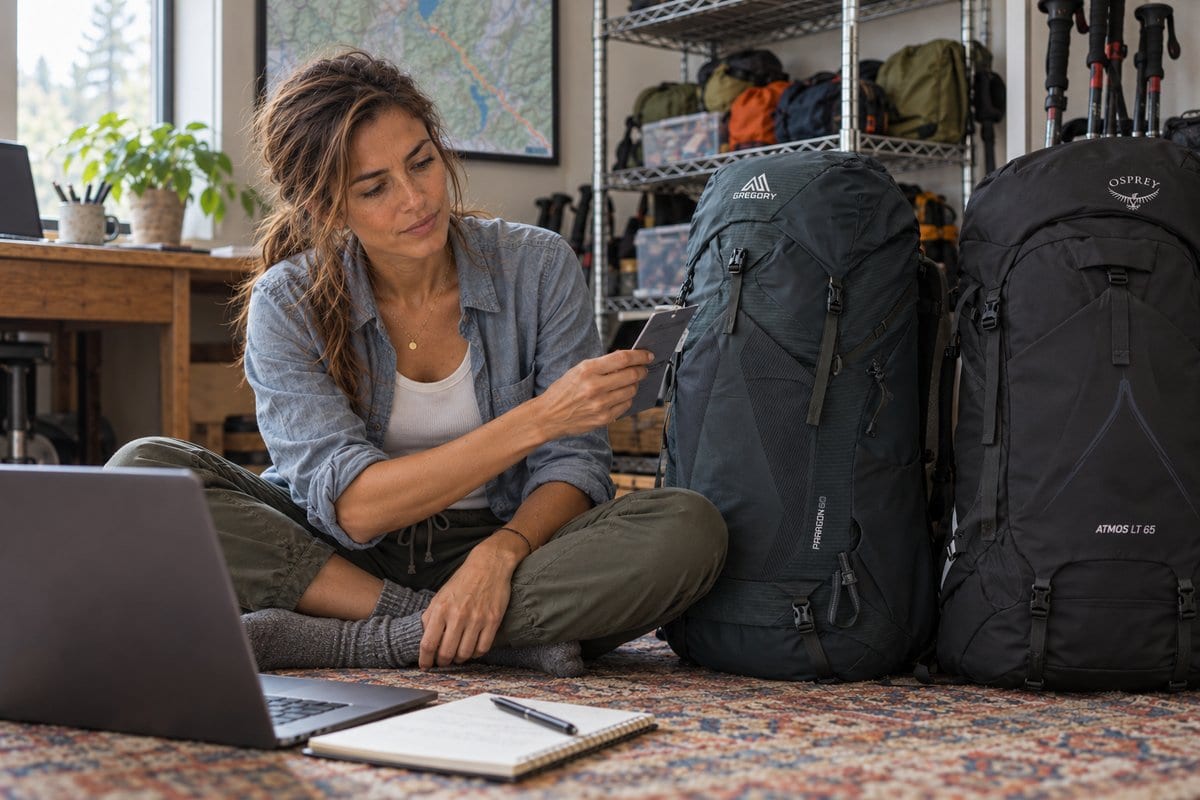
A pack loses the comparison the moment its torso range, hipbelt, or suspension does not fit your body. That is why these picks are buyer matches, not a podium.
The Paragon 60 uses a ventilated back panel with a moving hipbelt that adjusts as you move. It is designed for moderate conventional loads. The evidence does not establish a verified universal load ceiling, so the working rule is fit first, then test with your actual gear weight. Gregory's torso range and hipbelt adjustability are strengths for getting a custom-like fit from an off-the-shelf pack.
The Atmos AG LT 65 has exact-model evidence from owner reviews supporting comfortable week-long carries. Its suspended mesh keeps the pack body off your back, shifting the carry feel compared to a direct-contact panel. No verified universal load ceiling is documented for this model either; the owner-reported experience is for multi-day trips with typical resupply loads.
The Mariposa 60 has the clearest boundary: Gossamer Gear states 30 pounds as the comfort guideline and 35 pounds as the maximum. At 34.2 to 35.7 ounces for a medium, it is the lightest pack here by a wide margin, but its removable SitLight foam frame and pad-based structure shift more weight to your shoulders than a framed conventional pack. It suits a kit that already carries most of its weight low and close.
Fit the suspension to your torso first, and only then compare the rest. A pack that does not fit cannot work regardless of its feature list.
Ventilation and Trail Access
Ventilation is the main reason to choose the Atmos AG LT, but access preferences are what keep you happy with the choice day to day.
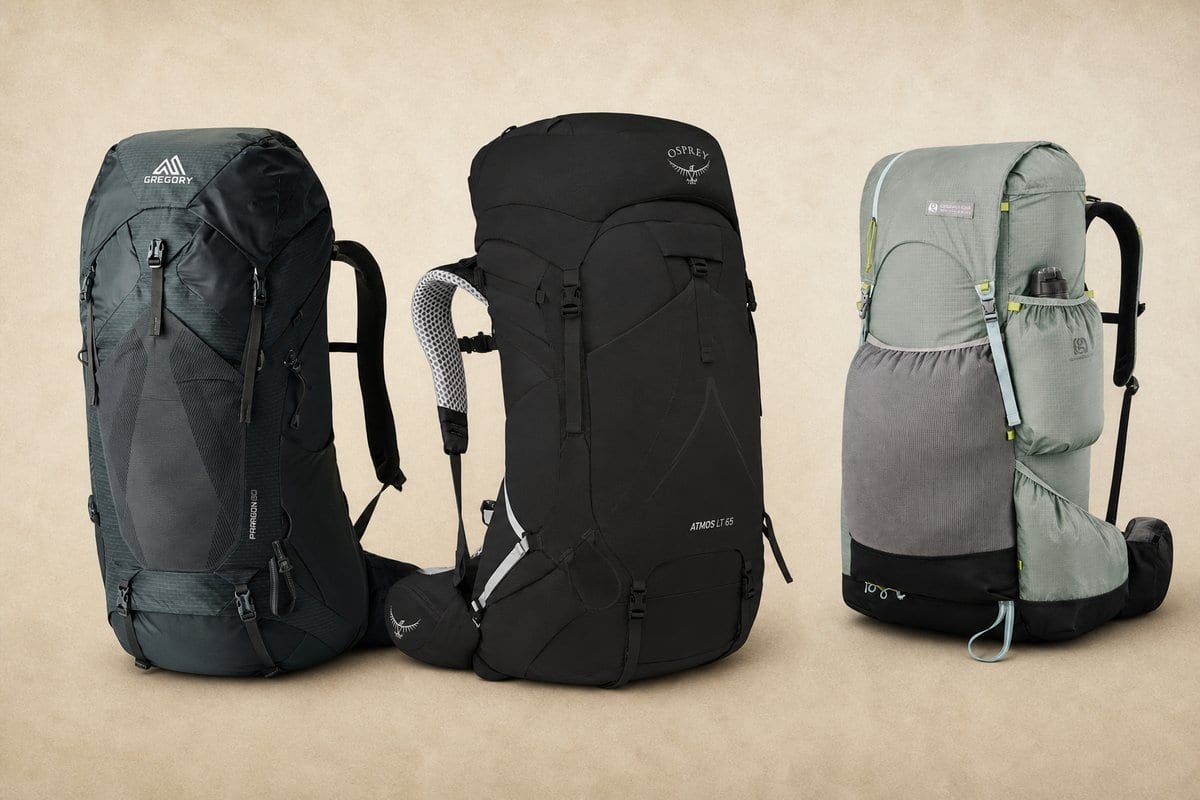
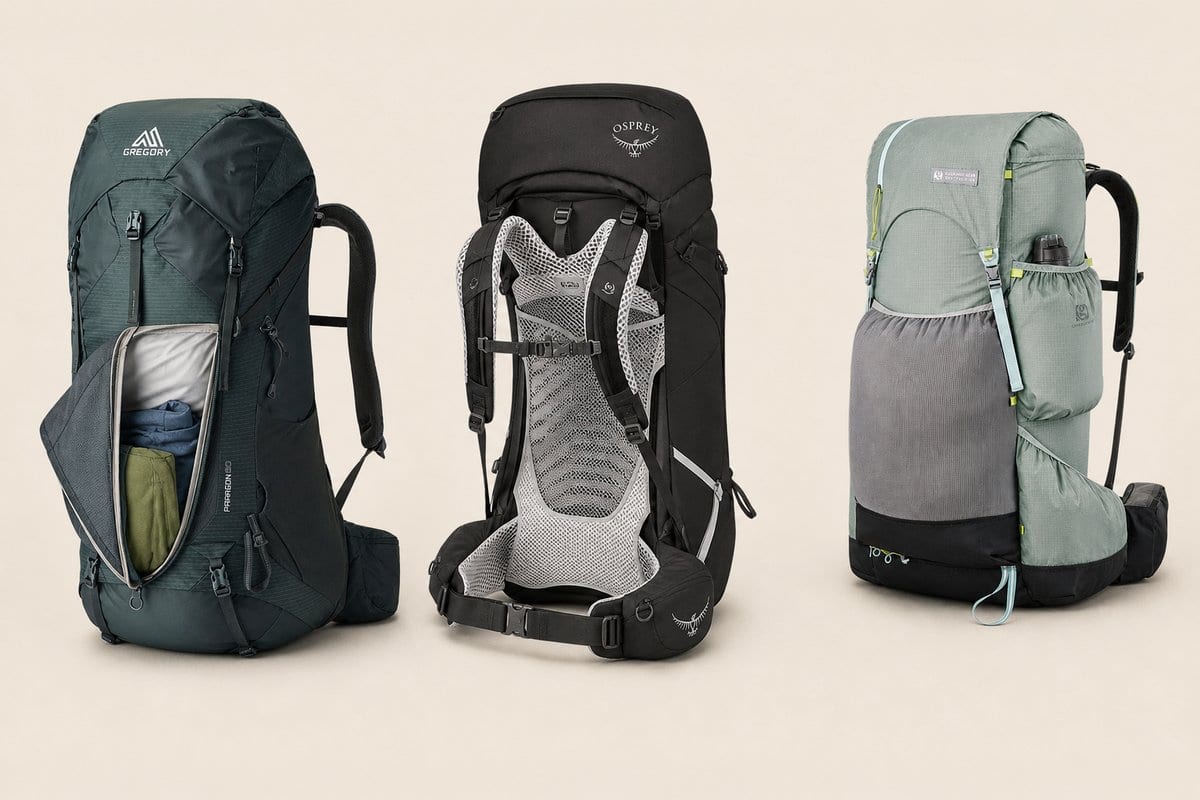
The Atmos AG LT 65 is the ventilation-first pick because its suspended mesh creates the most separation between pack and back among the three finalists. That air gap helps keep your back cooler on warm exposed trails. The tradeoff is the traditional top-loading layout: fewer external access points than the Paragon and no bottle-side reach while hiking.
The Paragon 60 still prioritizes airflow, but with less back-to-pack separation and a different carry feel. What it adds is convenience: side-access zippers and bottle pockets mean you can reach water and smaller items without removing the pack. For hikers who stop frequently for snacks or hydration, this makes a real difference in how often you handle the pack during the day.
The Mariposa 60 uses a SitLight foam pad rather than a suspended mesh back panel, so ventilation is comparable to a closed-panel design with some airflow around the edges. Its access is pure top loading plus seven exterior pockets: large mesh front and side pockets, plus shoulder strap and hipbelt storage. The pocket system replaces internal organization for compact kits where every item has a designated outside stash spot. There is no side or front zipper to the main body, so packing order matters more.
Match the access style to how often you reach into the main compartment on trail. Frequent access favors the Paragon. Ventilation-first favors the Atmos AG LT. External-pocket organization favors the Mariposa.
What the Evidence Does Not Prove
The evidence is strongest for different things on each pack, so a neat numerical ranking would overstate the research.
Comparable measured weights were not available across all three models. The Mariposa has a verified weight range (34.2 to 35.7 ounces for a medium), but the Paragon and Atmos AG LT were not weighed on the same scale or conditions, so pack weight should be treated as not directly comparable.
Exact-model long-term durability evidence is incomplete and uneven. The available research did not find two independent exact-model sources for frame durability, strap wear, or fabric longevity on any of the three packs. Claims in those areas would be inferred rather than verified.
Owner ratings are platform-specific, not crowd consensus. The Paragon's Amazon 3.1 out of 5 figure comes from only two ratings, far too small to move a verdict. The Atmos AG LT's 4.8 out of 5 across 135 ratings rests on a single platform alone, and no valid exact-model Mariposa aggregate was found. These signals are presented beside the verified facts rather than summed into a weighted crowd score.
The standard Osprey Atmos AG 65 was evaluated for this comparison but was disqualified because its current official product page could not be verified. No evidence from the Atmos AG LT was applied to the standard Atmos AG 65.
Who Should Skip Each Pack
Every pack here assumes a moderate conventional load. If your kit is lighter or heavier than that, these are not the right finalists for you.
Skip the Paragon if your base weight and total carry are already low enough for a true ultralight pack under two pounds. A framed pack with a moving hipbelt adds weight and complexity you do not need when your total load stays under 25 pounds. Also skip it if bulky gear (bear canister, winter bag, group shelter) regularly calls for a larger load hauler with a higher weight ceiling.
Skip the Atmos AG LT for the same light-kit reason, and especially when its suspended structure and higher pack weight solve a ventilation problem you do not have. If your typical climate is cool or dry and you rarely hike in conditions that make a closed back panel uncomfortable, the added weight and bulk of a suspended system is not worth the trade.
Skip the Mariposa when food, water, or seasonal gear regularly pushes you beyond 30 pounds. Its pad-based frame and removable stays trade load support for weight savings, so consistent heavy carries will be less comfortable than a framed pack. Also skip it if delicate exterior mesh will see repeated abrasion from brush or rock, since the large external pockets are more exposed than a fabric-paneled pack.
In every case, the right pack is the lightest one that fits your body and comfortably carries the full load you bring. Do not size up for features you will not use.
Get one honest gear take every Friday.
One email a week: new reviews, one gear pick with my reasoning, and nothing sponsored. Confirm your address and you get my printable 2-page backpacking gear checklist.
You'll get a confirmation link first, and nothing else arrives until you click it. Every email has a one-click unsubscribe. How your email is handled
More from Backpacks
Osprey Aether 65 Review: 4.9 lb of Load Hauler, and Who Should Skip It
The Aether 65 weighs 4.919 lb by Osprey's figure and is rated to 60 lb. The math on what that costs you at 30 lb is the whole review.
 Brooke Wilder
9 min read
Brooke Wilder
9 min read
Osprey Rook 65 Review: The Budget Pack That Does Most of an Atmos
The Rook 65 is a 3.7 lb budget pack with a mesh back panel and a rain cover in the box. Buy it for 30-40 lb trips; skip it for heavier loads.
Brooke Wilder
8 min read
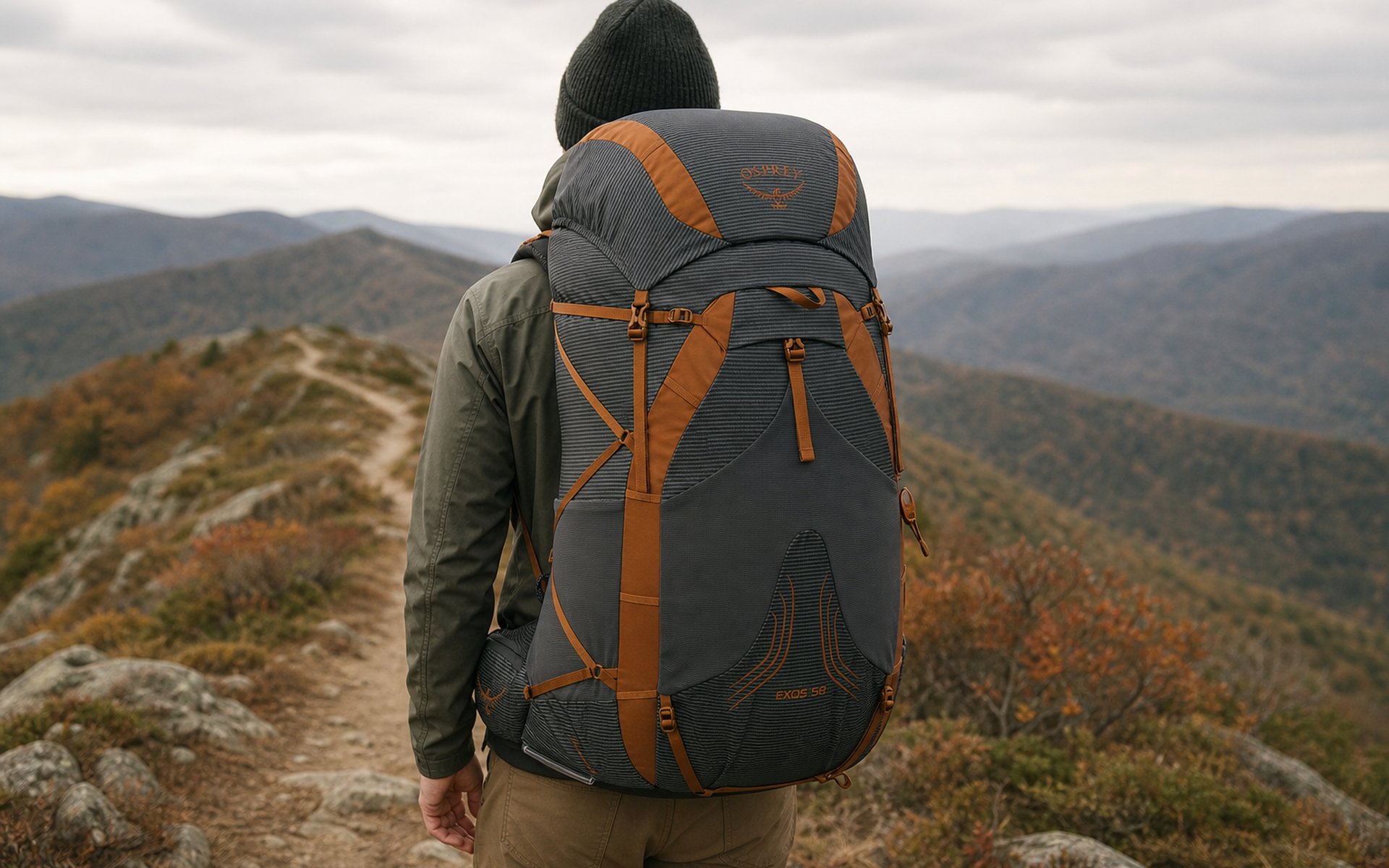
Osprey Exos 58 Review: The 2 lb 13 oz Pack That Carries 35 lb
The Exos 58 is a real frame and a ventilated back at 2 lb 13.4 oz, for 25 to 35 lb loads. Buy it in that window; skip it for ultralight kits or heavy hauls.
Brooke Wilder
9 min read
Why trust BestForBackpacking
Honest gear advice for backpackers, researched, weighed, and recommended.
Every pick is based on deep research: a synthesis of long-term owner reports, independent reviewer tests, and manufacturer specs, weighted by source independence, specificity, and use-case match. Brooke Wilder is our gear editor, the editorial persona who turns that research into a clear recommendation.